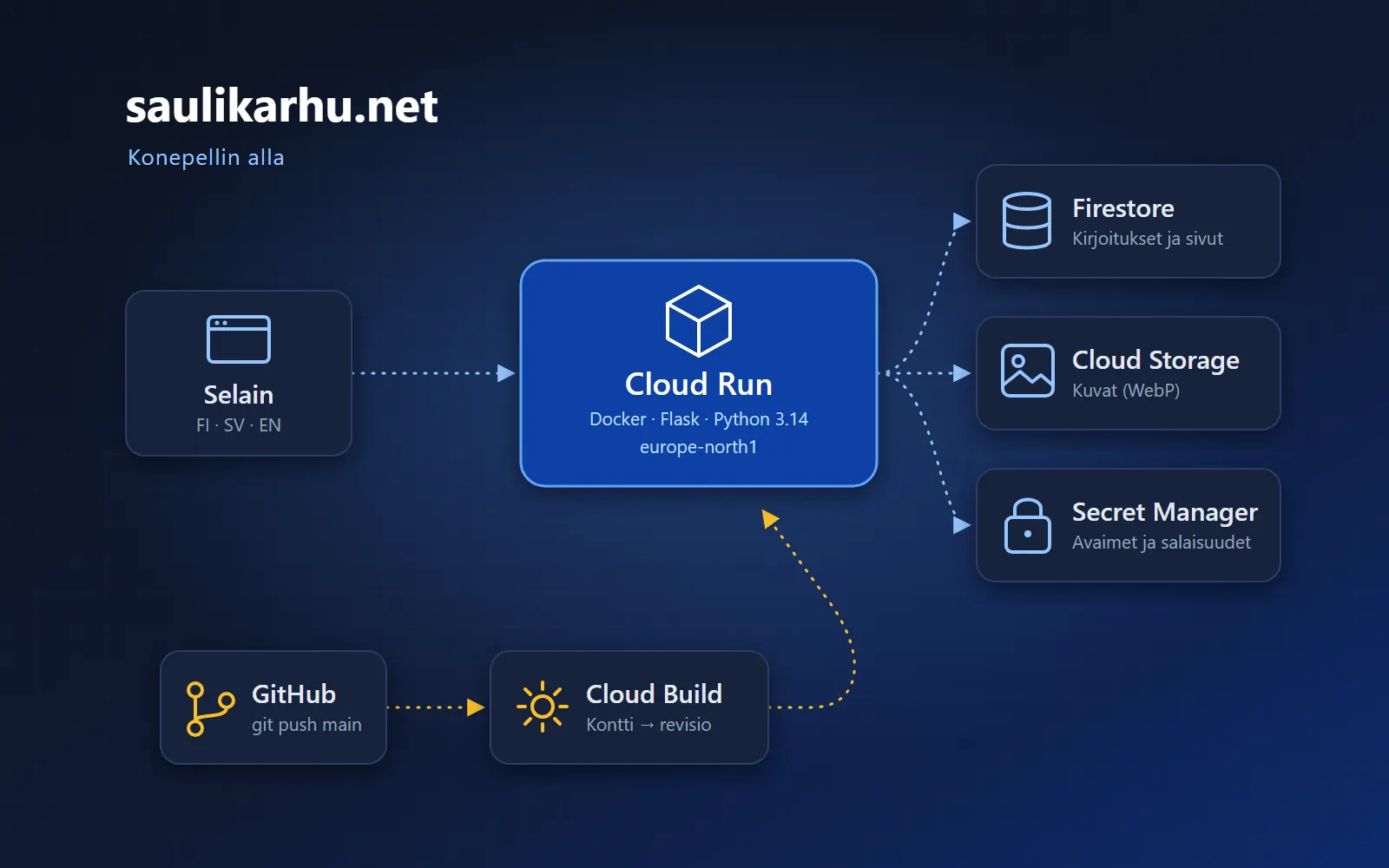
I mentioned earlier that I rebuilt this site during my winter holiday in 2026. Here is a technical description of what it is all about. The goal was a small, cheap and easy-to-maintain service that I can update myself without a separate publishing platform. As a long-time professional in the field (I built my first web service in 1995) who can make use of AI tools, I saw this project as doable without a huge time investment.
The architecture in brief
- Application: Python 3.14 and Flask, with pages built from Jinja2 templates. It runs on gunicorn with one process and eight threads.
- Runtime: Google Cloud Run in the Finland region (europe-north1). 256 MiB of memory is enough for the container.
- Database: Firestore in Datastore mode. Blog posts, categories, topics and the editable pages (home, About, Projects) are all stored as their own entities.
- Images: a Google Cloud Storage bucket, from which images are served straight to the browser.
- Login: Google OAuth. Only a list of allowed email addresses can edit content.
- Secrets: Google Secret Manager. There is not a single password or key in the code or the container.
So there is no separate server, database server or content management system. When nobody is reading the pages, Cloud Run can scale to zero, and costs stay very low. In practice, running this site has so far cost me less than 10 euros a month.
A home-made content management system
Instead of WordPress, the site has its own lightweight admin view. When I am logged in, I see the same pages as everyone else, plus edit buttons. The text editor is TinyMCE, installed from npm straight into the container, so nothing is loaded from an external CDN.
A post can be a draft, published or unpublished. Drafts are visible only to me. If I unpublish a post that has already been published, visitors get an HTTP 410 response ("removed") at its address instead of a plain 404, so search engines understand the situation too.
The HTML coming from the editor is cleaned when it is saved: scripts and event handlers are removed, and only YouTube and Vimeo embeds are allowed. Forms are protected with a CSRF token.
Image processing
When I upload an image, the server processes it with the Pillow library before storing it:
- a phone photo is rotated the right way up based on its EXIF data
- all metadata, including GPS location, is removed
- WebP versions 1600 and 800 pixels wide are created
On the pages, images are loaded with srcset, so a phone fetches the smaller version. File names are unique, so images can be cached for a year.
Three languages
The site works in Finnish, Swedish and English. The Finnish text is the main version, and translations are stored in language-specific fields of the same entity. I mainly write in Finnish and use AI to help with the translations, which I do check, though :) If there is no translation, the Finnish text is shown. The language is chosen with the flag selector, and the choice is remembered in a cookie. Otherwise the browser's language setting is used.
Look and feel
The design is built with Tailwind CSS. The CSS is compiled when the container is built, so the browser only gets one small minified file. Fonts and Lucide icons are also served from the site itself. The site has a dark and a light mode.
Deployment pipeline
The code is on GitHub. When I push a change to the main branch, Cloud Build starts automatically:
- The Docker image is built in two stages: first a Node stage compiles the CSS and copies the browser libraries, then a Python stage assembles the actual application.
- The image is pushed to Google's container registry.
- Cloud Run gets a new revision, and traffic moves over to it.
If something goes wrong, traffic can be rolled back to the previous revision with a couple of commands. Locally, I test the same container with Docker Compose before I push anything to production.
AI in the mix
As I mentioned earlier, I built this with the help of AI. I use Claude Code, a tool I also know well from work. I have given Claude project-specific instructions and safeguards: for example, commands that affect production and pushes to the main branch always need my approval. AI writes code fast, but the architecture, the decisions and the responsibility are still mine.
Data security has been considered throughout the project. The site runs under its own service account with only the permissions it needs, the HTML of posts is cleaned against a list of allowed tags, and the pages send security headers such as a Content Security Policy.
If you are building something similar and want to swap ideas, get in touch :)